Why DC Ranch and Silverleaf Homes Have the Most Demanding HVAC Requirements in the Valley
North Scottsdale’s DC Ranch and Silverleaf sit high against the McDowell Mountains, where sun exposure, elevation, and luxury construction raise the bar for HVAC design and installation. The homes are larger, the glazing is heavier, the ceilings soar, and indoor air expectations rival resort standards. In short, these properties need more than generic AC services in Scottsdale. They need disciplined engineering, correct load calculations, and equipment choices that survive 115-degree summers and monsoon grit while delivering quiet comfort room by room.
Day and Night Air Conditioning, Heating and Plumbing has served the Valley since 1978, and the technicians see the same pattern in DC Ranch and Silverleaf: systems sized by square footage instead of Manual J, attic ductwork undersized for variable-speed systems, west-facing glass without coordinated zoning, and condensers choking with caliche after one dust event. When that happens, even a high-end unit struggles. This article explains why these neighborhoods push HVAC to the limit, what correct design and installation look like in Scottsdale 85255 and 85262, and how current standards like SEER2 and the 2026 R-454B refrigerant transition change equipment selection for new and replacement projects.
Elevation, Orientation, and Envelope: Why Loads in DC Ranch and Silverleaf Run Hotter
These communities sit along the Pima Corridor near Loop 101 and Thompson Peak Parkway, straddling desert foothills with intense solar exposure. Many homes have expansive west and south glass with mountain or golf course views, open floor plans with 12- to 16-foot great rooms, and detached casitas. That envelope profile, combined with the Valley’s climate zone 2B hot-dry classification under ASHRAE 169, yields a cooling design target of roughly 110 to 117 degrees at the 99 percent summer percentile. Real-world rooftop and equipment pad readings are higher. At west exposures, technicians measure 130 to 140 degrees at late-afternoon condenser locations in July and August. That ambient heat derates capacity and shortens component life if the system is not sized, installed, and ventilated correctly.
In DC Ranch and Silverleaf, solar gain and infiltration, not just square footage, set the true tonnage. A loft open to a two-story foyer with clerestory windows will overwhelm a rule-of-thumb estimate. Manual J Residential Load Calculation under ACCA Standard 1 accounts for actual window count and orientation, attic R-values, roof color, internal gains from cooking and lighting, and infiltration rates. Correct sizing prevents two costly outcomes that are common in the area: a 30 to 50 percent oversized system that short-cycles and leaves indoor humidity higher during monsoon weeks, or an undersized system that runs 20 to 22 hours a day to hold 78 degrees and burns out compressors early.
What Large Scottsdale Luxury Homes Demand from HVAC Equipment
These properties need capacity that holds during late-afternoon desert peaks, control that handles zone-by-zone setpoints without starving any room of airflow, and efficiency that actually performs in high ambient rather than on a brochure. That means:
- Variable-speed or inverter-driven condensers rated at least 18 SEER2 when budget allows, paired with communicating air handlers and matched coils to preserve EER2 under 110-plus-degree outdoor conditions. Manual D duct design to move the static pressure the equipment needs, with trunks and branches sized for low noise at high CFM and with dampers for focused zone control. Zoning that aligns to the architecture: owners’ suite, great room and kitchen, upstairs bedrooms, home office, casita. One thermostat for 6,000 square feet is not control. It is guesswork. High-MERV filtration (MERV 11 to 13) sized for the blower so pressure drop stays within manufacturer limits, plus UV or polarized media for indoor air quality when family health is a priority. Outdoor unit placement that avoids west-facing heat islands and provides service clearance, with coil coatings that resist monsoon dust adhesion and corrosion.
For Scottsdale replacements in 2026 and beyond, the refrigerant standard changes. The federal R-454B transition effective January 1, 2026 under EPA SNAP Rule 24 ends new R-410A equipment manufacturing. R-454B is an A2L mildly flammable refrigerant with a global warming potential of 466 versus R-410A’s 2,088. It requires specific indoor concentration limits, compatible leak detection at certain installations, and technician certification that covers A2L handling. Existing R-410A systems can still be serviced with available stock and recovered refrigerant, but new installations shift to R-454B or other A2L alternatives like R-32. In DC Ranch and Silverleaf, where mechanical rooms may be inside the envelope and equipment sits near living spaces, proper A2L design and code compliance matter.
The SEER2 Reality in the North Scottsdale Desert
SEER2 replaced SEER in 2023 with a tougher M1 test procedure that better represents ducted system reality. For the Southwest region, the minimum for split systems under 45,000 BTU is 14.3 SEER2 and 11.7 EER2. In North Scottsdale, higher SEER2 does save energy, but the peak hour strain often separates mid-tier systems from premium inverter systems. An 18 to 20+ SEER2 variable-speed unit maintains capacity and lowers sound at 4 to 6 tons even as outdoor temps climb above 110. The homeowner feels the difference in steadier room temperatures, lower afternoon kWh draw, and fewer nuisance trips due to overheating.
That said, efficiency alone is not comfort. Without correct duct static pressure, return sizing, and zone setup, a 20 SEER2 unit will behave like a 14.3 SEER2 unit under duress. This is where Manual S equipment selection and Manual D duct design integrate with the Manual J load to form a system, not just a purchase.
Monsoon Dust, Caliche, and the 15 to 25 Percent Capacity Hit
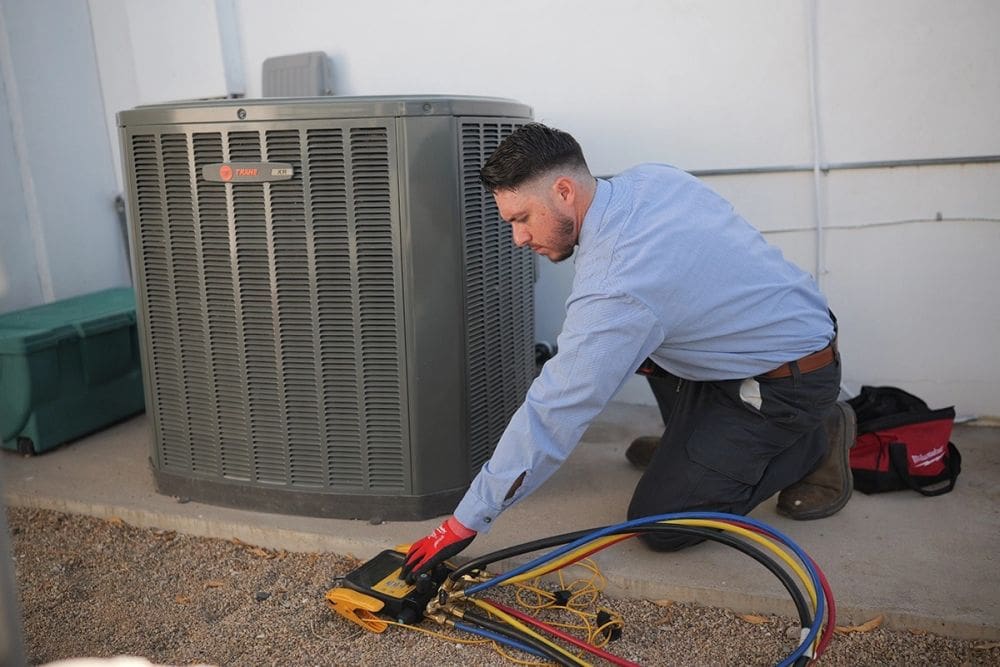
From June through September, haboobs sweep caliche fines into every outdoor condenser coil in Maricopa County. DC Ranch and Silverleaf are no exception. After a single storm, measuring static pressure and delta-T across the coil will show a capacity loss of 15 to 25 percent until the condenser coil is cleaned. The condenser coil is the heat-rejecting radiator on the outdoor unit. When dust packs the thin aluminum fins, heat cannot leave the refrigerant efficiently. The compressor runs hotter, the run capacitor works harder every start cycle, and head pressure climbs. A coil that looks “not too bad” from the outside can be packed in the middle core. This pattern is why same-summer cleanings are common across the 85255 and 85262 zip codes after back-to-back storms.
In addition, sustained 130- to 140-degree pad temperatures at west exposure locations drive a disproportionate rate of run capacitor failure every June and July across the Valley. The run capacitor is the cylindrical electrical component that stores and releases an energy pulse to help the compressor motor start each cycle. It sits in the outdoor unit and ages faster under heat. Day and Night sees this failure across Phoenix zip codes 85016, 85018, 85044, 85048, 85050, and also up the Pima Corridor, and stocks high-quality capacitors on the service trucks because of it.
Why Oversizing and Poor Zoning Hit DC Ranch and Silverleaf Harder
Square-footage tonnage rules miss critical design variables in these homes. A 5-ton guess for a 2,500-square-foot single-story space is wrong if the great room has a glass wall to the west, a 16-foot ceiling, and an open kitchen adding internal heat. Conversely, some casitas with shaded exposures and good envelope performance do well with a smaller inverter head or a ducted mini split. Oversizing increases short cycling, especially in shoulder months and evenings. That short cycling drives poor humidity control during monsoon weeks and reduces compressor life. In the Valley, that can mean compressor failure years earlier than a correctly sized system would experience.
Mismanaged zoning is the second common fault. One zone spanning upstairs bedrooms and the downstairs great room leaves at least one area unsatisfied. Too many small zones without a bypass plan will raise static pressure and cause whistling vents, hot rooms, and control board faults. Correct zone setup uses dampers sized for airflow, a zone control board that can stage or modulate capacity, and ductwork that supports both the minimum and maximum airflow of the chosen equipment. Inverter systems excel here when the duct system is designed for them.
Inside Air Matters: Filtration, UV, and Fresh Air in a Hot-Dry Climate
DC Ranch and Silverleaf owners often ask for “hotel air.” In the desert, that means filtration that removes dust and fine particulates without choking airflow, UV or bipolar ionization for coil cleanliness and microbial reduction, and measured fresh air delivery during cooling hours. The combination must protect against pressure drop that kills efficiency. A MERV 11 to MERV 13 filter in a correctly sized media cabinet strikes a strong balance, especially with a variable-speed blower that can compensate across the cycle. A UV light at the evaporator coil keeps biofilm low. For fresh air, a motorized outside air damper paired with the air handler, sized for the load and local code, gives controlled dilution without uncontrolled infiltration through unsealed envelope gaps.
2026 Refrigerant Transition: What R-454B Means in Scottsdale Homes
New AC and heat pump systems produced January 1, 2026 and later will use A2L refrigerants such as R-454B or R-32. R-454B carries a GWP of 466, which reduces climate impact versus R-410A. It is mildly flammable, which requires attention to leak detection, line length limits, and indoor concentration thresholds based on room volume. This is routine work for trained technicians, but it is not optional. Equipment selection should consider available line set lengths, coil compatibility, and code-approved installation practices for A2L systems. The Day and Night team fields R-454B transition-trained, EPA Section 608 certified technicians who handle these installations daily as manufacturers release their R-454B lines across Trane, Carrier, Lennox, Goodman, and Rheem.
Scottsdale homeowners with R-410A systems do not need to panic. Those systems can be serviced for many years using existing supplies and recovered refrigerant. But in 2026 and beyond, when facing a major repair on a 10- to 14-year-old R-410A system, replacement math changes. New equipment incentives apply to R-454B heat pumps and high-efficiency systems. Parts for legacy platforms grow more scarce over time. This calculus is part of any installation estimate Day and Night prepares in DC Ranch, Silverleaf, and Grayhawk.
Energy Incentives in 2026: How Scottsdale Projects Stack Savings
For AC and heat pump replacements in the Scottsdale and Phoenix utility territories, current incentive programs can help offset premium equipment and zoning costs. As of 2026, APS Cool Rewards Program offers up to $2,000 for qualifying heat pump installations. SRP’s HVAC Rebate Program offers up to $1,500 on qualifying high-efficiency AC installations. The federal Inflation Reduction Act Section 25C Energy Efficient Home Improvement Credit provides up to $2,000 annually for qualifying heat pumps and up to $1,200 annually for other eligible improvements through 2032. Combined, DC Ranch and Silverleaf homeowners can see as much as $5,500 in incentives for a qualifying high-efficiency heat pump installation with proper paperwork.
On a large luxury residence where multi-zone inverter systems and duct improvements create real comfort gains, these rebates and credits help close the gap between mid-tier and premium options. Proper documentation and equipment selection are required. That is handled at the estimate stage so there are no surprises at tax time.
What a Correct North Scottsdale Installation Looks Like
The installation process should start with a Manual J load calculation for the entire structure and any detached space, based on actual measurements and envelope details. ac services That load feeds Manual S equipment selection to choose capacity, staging, and turndown ratio. Manual D follows to design duct sizes, tap locations, returns, and dampers that meet airflow at acceptable static pressure and noise levels. Each of these steps is non-negotiable in DC Ranch and Silverleaf if the goal is uniform temperatures and quiet operation, even in the great room at 4 p.m. In August.
On the mechanical side, condenser placement matters. If possible, avoid west-facing walls. Provide shade that does not block service access or airflow. Confirm line set insulation thickness appropriate for high ambient and UV. Select a condenser coil design that resists fouling and is straightforward to clean during monsoon season. Inside, place air handlers for service access, condensate management, and noise control. Confirm that the condensate drain has a cleanout, a trap per code, a secondary pan, and a float switch to stop the system during a clog rather than flooding a foam roof or second-story ceiling.
Thermostats should be smart but sensible. Ecobee, Nest, or manufacturer communicating controls work when they are integrated with zones correctly. Do not hide a thermostat on an interior wall that picks up no solar load while a room of glass bakes. Sensor placement and zoning go together.
Shareable Scottsdale HVAC Fact: The Two Numbers That Drive Most DC Ranch Retrofits
Two numbers explain many retrofits in DC Ranch and Silverleaf. First, 15 to 25 percent. That is the typical capacity loss measured on dirty condenser coils after a June or July dust storm, which remains until cleaned. Second, 30 to 50 percent. That is how much oversized many North Scottsdale systems are when originally “sized” by square footage rather than a Manual J in this solar-heavy housing stock. Oversizing plus dirty coils equals hot rooms, high kWh, and short equipment life. Both numbers are preventable with correct design and scheduled maintenance.
Why These Homes Benefit from Ductless and Hybrid Solutions
Even with well-designed central systems, the casita, wine room, gym, or home office may benefit from a ductless mini split. Mitsubishi Electric ductless systems excel in spaces with specific schedules and loads. For example, a detached casita with west exposure often performs best with its own inverter unit, not as a starved end-run of the main home system. Likewise, a dual-fuel setup that pairs a heat pump with a gas furnace (hybrid system) can reduce winter gas use and deliver quiet shoulder-season heat, which many North Scottsdale owners prefer for morning comfort in December and January.
Plumbing Realities That Touch HVAC in North Scottsdale
HVAC and plumbing often meet at the water heater and condensate lines. Scottsdale draws from the same Central Arizona Project (CAP) supply Phoenix uses, which runs 12 to 18 grains per gallon in hardness with 200 to 300 ppm calcium carbonate equivalent. That mineral content accelerates scale in tankless water heater heat exchangers if annual descaling is skipped, and it eats water heater anode rods in 3 to 5 years versus 6 to 8 years in softer water markets. Where air handlers and water heaters share a mechanical room, plan space for service and for condensate routing that never ties illegally into a drain without an air gap. Correct expansion tanks, dielectric unions, and pressure regulating valves keep the plumbing side compliant with the Arizona Plumbing Code, which adopts the 2018 International Plumbing Code with state amendments.
Separate from Scottsdale, Day and Night also fields slab leak and sewer expertise across Phoenix. In Arcadia 85018 and Biltmore/Camelback East 85016, many mid-century ranch homes still run original 1960s ductwork and cast iron drains. The team documents 35 to 40 percent supply air loss in some of these homes due to unsealed or damaged ducts, and cast iron drain failures are common in homes built before 1985. While not the typical profile in DC Ranch and Silverleaf, these patterns show the company’s depth across Maricopa County, from Maryvale 85033 to Ahwatukee 85044 and 85048 and Desert Ridge 85050 and 85054.
Maintenance That Actually Protects a North Scottsdale Investment
For AC services in Scottsdale that hold value in the long term, maintenance cannot be a checkbox. On large systems, biannual service is the baseline: spring cooling inspection and fall heating inspection for heat pumps. The spring visit should include a deep condenser coil clean, not just a hose rinse, electrical testing of the run capacitor and contactor under load with a meter that reads capacitance and voltage drop, refrigerant charge verification using subcooling and superheat, and a thermostat and zone test. The evaporator coil should be checked for cleanliness and airflow. Filter cabinets should be sealed, with media sized to the system’s airflow and replaced on schedule. The fall visit runs the heat mode, tests the reversing valve, and confirms defrost strategy on heat pumps.
For homes that schedule a holiday return or own multiple properties, connected thermostats and maintenance membership can prioritize dispatch during the most demanding parts of summer. The difference between a same-day coil cleaning after a July haboob and a two-week lag can be 10 to 15 degrees in the hottest room each afternoon and a high electricity bill that does not drop until the coil is clear.
Commercial and HOA Considerations Along the Pima Corridor
Many DC Ranch parcel associations and Silverleaf HOAs manage communal spaces with rooftop packaged units. These systems face constant thermal load and dust. When a packaged unit cycles off under high head pressure alarms on a Saturday event, the cause is often coil blockage combined with drifting refrigerant charge or a failing fan motor that cannot move enough air at 130-degree rooftop ambient. Commercial service programs should include quarterly coil care in monsoon months and torque checks on electrical connections that loosen under thermal expansion and contraction. When replacement time comes, variable-speed packaged options with 15+ SEER2 ratings and demand control ventilation align with both comfort and energy targets for these properties.
Loop 101 Access and True Scottsdale Responsiveness
Response time matters when a great room is climbing into the 90s at 6 p.m. The proximity to Loop 101 and Pima Road allows quick access from Phoenix headquarters to North Scottsdale neighborhoods. Crews move from 3669 E La Salle St near the Phoenix Sky Harbor corridor up SR 51, across Loop 101, and into DC Ranch, Silverleaf, Grayhawk, Troon, and McDowell Mountain Ranch daily. During an active monsoon pattern, the dispatch team staggers crews to cover late-day calls when dust and lightning produce widespread failures. That is how 24/7 AC services in Scottsdale look in practice, not in slogan.
Why DC Ranch and Silverleaf Homes Often Need Multiple Systems
A single 5-ton for a 4,200-square-foot residence with open volume rarely holds in peak season if the envelope carries west glass and the duct system splits in too many directions. Many luxury homes run two to four systems, each with purpose-built zoning. Upstairs spaces often pair well with a dedicated inverter system that carries the late-afternoon load after the main floor system ramps down. This approach also limits noise in the great room during dinner hours because the blower does not need to blast through an entire house worth of duct to satisfy a single hot bedroom.
In terms of equipment mix, Trane remains a strong choice for high ambient cooling, with Carrier, Lennox, Goodman, and Rheem supplying excellent variable-speed options as well. The brand choice should match load profile, duct static, and serviceability preferences. What matters more than the sticker is the integration of equipment, duct, and controls proven to work in the Valley’s most punishing weeks.
Permits, Licenses, and Safety: Non-Negotiables in Scottsdale
HVAC contractors working on these homes must carry the right Arizona Registrar of Contractors licenses: ROC C-39 for air conditioning and refrigeration, and ROC C-37 for plumbing when that scope intersects the job. A2L refrigerant handling requires EPA Section 608 certification and specific training for R-454B. Sealed combustion clearances, gas line work for furnaces, and electrical service sizing for inverter systems must meet code and manufacturer specifications. Scottsdale inspections will check for these items, and skipping them risks both comfort and liability. Homeowners should expect up-front, flat-rate proposals that include permits and inspection coordination.
Why This Matters Beyond North Scottsdale
The same physics driving DC Ranch and Silverleaf HVAC decisions appears across the Valley. In Arcadia and the Biltmore Corridor, mid-century duct systems often leak 35 to 40 percent of supply air into the attic before it reaches the rooms. In Ahwatukee and Desert Ridge, direct west exposures cook condenser pads to 130 to 140 degrees, spiking run capacitor failure calls each June and July. Maryvale 85033 and Sunnyslope 85020 show the monsoon coil blockage trend clearly: a single dust storm drops capacity by up to a quarter until cleaning. These regional facts explain why AC services in Scottsdale that work in April may falter in July if they were never engineered for the 99 percent summer design conditions.
What to Expect From a Serious North Scottsdale Estimate
An estimate for a DC Ranch or Silverleaf HVAC replacement should read like a plan. It should include a Manual J summary, duct improvements with sizes and materials, zone definitions by area, equipment model numbers with SEER2 and EER2 ratings, thermostat strategy, and details on condensate, electrical, and permits. It should also address the R-454B refrigerant platform timing, the APS and SRP rebate pathway, and the federal Section 25C credit for qualifying heat pumps. If a contractor cannot explain how the system will handle a 4 p.m. West sun load in August in the great room and master suite at the same time, the design is not complete.
A Clear Line Between Service and Engineering
AC services in Scottsdale cover a wide range, from an emergency run capacitor swap to a full multi-system retrofit with zoning and new ducts. DC Ranch and Silverleaf projects sit near the engineering end of that spectrum. The homes are complex, the expectations are high, and the cost of mistakes rises with the property. The payoff for doing it right is real: cooler rooms at peak, quieter operation, longer compressor life, and energy bills that match the equipment ratings more closely instead of falling off under high ambient stress.
Serving the Entire Valley From a Phoenix Base
Operating from Phoenix 85040, the team covers Scottsdale, Paradise Valley, Tempe, Mesa, Chandler, Gilbert, Glendale, Peoria, and the rest of Maricopa County. The technicians know the freeway grid from I-10 and I-17 to Loop 101, Loop 202, and US 60. They work commercial rooftops along the Camelback Corridor, residential change-outs in Encanto and North Phoenix, and brand-new builds in Fountain Hills and Cave Creek. That breadth informs every Scottsdale estimate, because the crew has seen what lasts in 115-degree summers and what fails when Get more information monsoon dust meets underdesigned systems.
Why DC Ranch and Silverleaf Homes Have the Most Demanding HVAC Requirements in the Valley
It comes down to climate, construction, and expectation. The climate is severe at peak. The construction is large, open, and often glass-heavy. The expectation is silent, steady comfort across every room. Meeting that target requires Manual J, Manual S, and Manual D. It requires variable-speed systems that keep capacity at high ambient. It demands zone control that matches how people live in the space, real filtration without suffocating airflow, and maintenance that treats monsoon dust like the capacity killer it is. When those elements align, even a 5,500-square-foot North Scottsdale home can feel cool and quiet at 4 p.m. In August without a system straining at 100 percent duty cycle day after day.
Ready for AC Services in Scottsdale That Stand Up to DC Ranch and Silverleaf?
Day and Night Air Conditioning, Heating and Plumbing has served Maricopa County since 1978 from its Phoenix headquarters at 3669 E La Salle St in 85040. The company holds Arizona ROC C-39 HVAC and ROC C-37 plumbing licenses, fields EPA Section 608 certified technicians trained on the R-454B A2L refrigerant transition, and provides true 24/7 emergency response Valley-wide. Homeowners in DC Ranch, Silverleaf, Grayhawk, and across Scottsdale receive upfront flat-rate pricing before work begins, same-day availability for urgent repairs, and free estimates on new HVAC system installations with APS, SRP, and federal IRA Section 25C documentation support for qualifying projects. For AC services in Scottsdale that solve peak-season comfort issues and meet 2026 standards, call (602) 584-7758 or request an estimate online. Financing is available through approved lenders, and all installations include manufacturer-backed equipment warranties and a workmanship warranty on labor.
Day & Night Air Conditioning, Heating & Plumbing AZ Licenses: ROC335883 | ROC335884 📍 Phoenix Headquarters 3669 E La Salle St,
Phoenix, AZ 85040 📞 24/7 Service Phone (602) 584-7758 Get Directions Visit Website 📘 Facebook 📸 Instagram 💼 LinkedIn